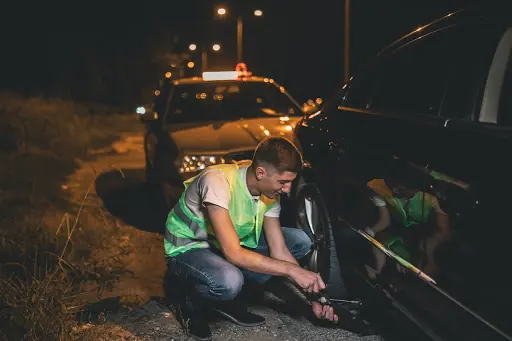
If your vehicle stops working, the first question is often whether you need roadside assistance or towing. Roadside assistance makes sense when a minor problem can be handled safely where the vehicle sits. Towing is usually the better choice when the vehicle cannot be repaired roadside or is no longer safe to drive.
After more than 30 years of towing and roadside experience, I recommend looking at three things first: what happened, whether the vehicle is safe to drive, and whether the problem can realistically be solved where you are.
What Is Roadside Assistance?
Roadside assistance is designed for problems that may be resolved without transporting the vehicle somewhere else.
For example, your car may be mechanically sound but unable to move because the battery is weak, a tire is flat, or you ran out of fuel.
Common roadside assistance situations may include:
- Dead or weak batteries
- Jump-start assistance
- Flat tires when roadside conditions allow safe service
- Running out of fuel
- Minor roadside problems that do not require vehicle transportation
If the problem can be corrected safely and the vehicle is otherwise operating normally, roadside assistance may be all you need.
What Is Towing?
Towing moves the vehicle from its current location to another destination when it cannot or should not continue driving.
That destination might be a repair shop, dealership, residence, storage facility, or another authorized location.
You may need towing when the vehicle has:
- Serious mechanical failure
- Severe overheating
- Transmission problems
- Steering or suspension damage
- Collision damage
- A damaged wheel or multiple flat tires
- Major fluid leaks
- An electrical problem that cannot be resolved with a jump start
In these situations, continuing to drive can cause additional damage or create a safety problem.
When Is a Jump Start Enough?
A jump start can be enough when the battery is simply discharged and the vehicle starts and operates normally afterward.
For example, you may have left a light on while the vehicle was parked. Once the engine starts, the charging system may operate normally.
However, a jump start does not fix every electrical problem. If the vehicle starts and immediately dies again, warning lights remain on, or the charging system is failing, you may need a tow to a repair facility.
In other words, the jump start gets the engine running. It does not automatically mean the underlying problem is solved.
Does a Flat Tire Require Roadside Assistance or Towing?
A single flat tire may only require roadside assistance if you have a usable spare and the vehicle sits in a location where changing the tire can be done safely.
However, towing may be the safer choice if the vehicle has multiple damaged tires, wheel damage, suspension damage, no usable spare, or is stopped somewhere that makes roadside work dangerous.
Location matters. Changing a tire in a quiet parking lot is very different from trying to work beside fast-moving traffic on I-4.
If roadside conditions are unsafe, do not risk your safety just because the repair itself seems simple.
What If You Run Out of Gas?
Running out of fuel is a good example of a problem that usually does not require towing.
Roadside gas assistance may provide enough fuel to get you moving and reach a nearby gas station.
However, if adding fuel does not allow the vehicle to start, another issue may be involved. At that point, towing may become necessary.
Does an Overheating Vehicle Need a Tow?
Overheating deserves more caution because continuing to drive an overheated engine can cause serious damage.
If the temperature gauge moves into the danger zone, a warning appears, or steam comes from under the hood, find a safe place to stop as soon as you can.
Do not open a hot cooling system. Pressurized coolant can cause severe burns.
Sometimes an overheating problem turns out to be relatively minor. However, without knowing why the engine overheated, continuing to drive can turn a manageable repair into a much more expensive one.
Therefore, towing is often the safer choice when an engine has seriously overheated.
What About a Vehicle After an Accident?
After a collision, a vehicle may look driveable even when hidden damage makes driving unsafe.
For example, an accident can damage steering, suspension, wheels, tires, cooling components, lights, or fluid systems.
If you notice leaking fluids, damaged wheels, steering problems, rubbing tires, broken lights, unusual noises, or significant body damage, do not assume the vehicle is safe simply because the engine still runs.
Our Accident Towing page explains more about transporting damaged vehicles after a collision.
Can Roadside Assistance Turn Into a Towing Call?
Yes. Sometimes you do not know how serious the problem is until someone looks at the vehicle.
For example, you may initially believe you only need a jump start. However, if the vehicle will not remain running afterward, it may need towing.
Likewise, what looks like a normal flat tire could involve wheel, suspension, or accident damage.
That is why providing accurate information when you call matters. The more we know about what happened, the easier it is to determine what type of service may be appropriate.
5 Signs You Probably Need a Tow Instead of Roadside Assistance
As a general rule, I would lean toward towing when any of these conditions apply:
- The vehicle cannot safely move under its own power.
- The vehicle has significant accident damage.
- You see a major fluid leak, smoke, or severe overheating.
- Steering, wheels, tires, suspension, or brakes appear damaged.
- A simple roadside service did not solve the problem.
The goal is not to tow every vehicle. The goal is to avoid driving a vehicle that could endanger you, other motorists, or cause additional mechanical damage.
What Information Should You Provide When You Call?
Whether you think you need roadside assistance or towing, provide as much information as possible.
Try to have these details ready:
- Your exact location
- Vehicle year, make, model, and color
- What happened immediately before the problem
- Whether the engine starts
- Whether the vehicle rolls, steers, and brakes
- Whether you see leaking fluids or smoke
- Whether any tires or wheels are damaged
- Whether the vehicle was involved in an accident
- Your destination if towing is required
Also, mention if the vehicle is inside a parking garage, behind a gate, on private property, or in another location with restricted access.
Roadside Assistance vs. Towing: A Simple Rule
After more than 30 years of towing experience, this is the easiest way I explain it:
If the problem can be solved safely where the vehicle sits and the vehicle is safe to drive afterward, roadside assistance may be enough. If the vehicle cannot be made safe to drive at the roadside, tow it.
That rule covers most situations.
Do not let the inconvenience or cost of a tow pressure you into driving a vehicle that does not feel safe.
Need Roadside Assistance or Towing in Orlando?
If you are unsure whether you need roadside assistance or a tow, call Orlando Tow & Recovery. Tell us where you are, what vehicle you have, and what happened.
We can discuss your situation and the appropriate service based on the vehicle condition, location, access, and current availability.
We serve Orlando and selected surrounding Central Florida service areas.
About Wrecker Driver
Wrecker Driver shares practical towing, roadside assistance, vehicle recovery, and road safety advice backed by more than 30 years of experience.
Leave a Reply